GuidesWhy Outsourcing Your Fulfilment Is the Best Decision Your Business Can Make
Fulfilment Finder·13 June 2026
From elastic warehouse capacity to better courier rates and more sales channels, here is why outsourcing fulfilment to a specialist is the smartest move most ecommerce SMEs haven't made yet.
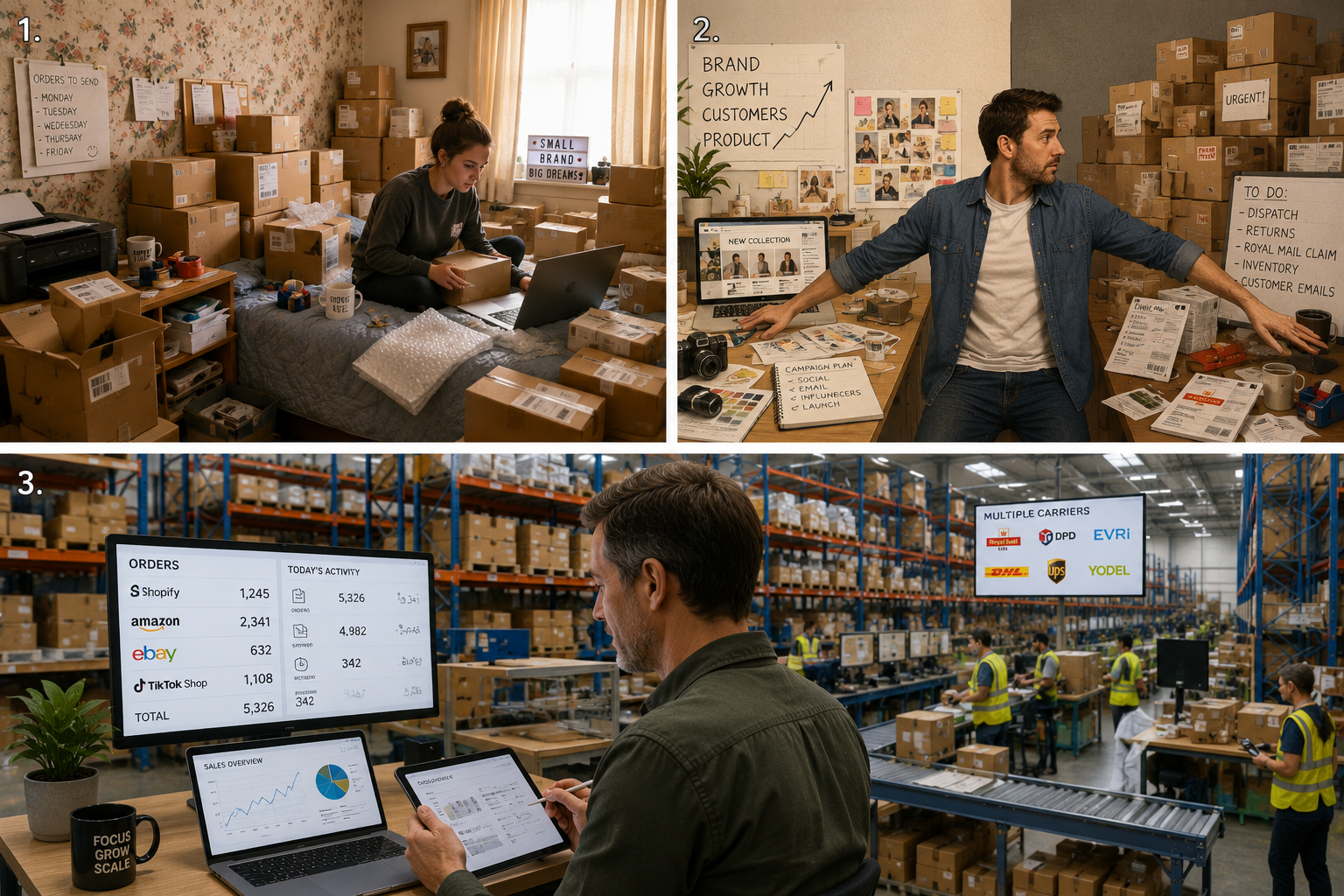
The warehouse in the spare bedroom
Britain's ecommerce entrepreneurs are brilliant at building brands, terrible at shipping them. It is time most of them admitted it
There is a particular kind of purgatory familiar to anyone who has built an ecommerce business from scratch. It begins innocuously: a few orders a day, packed on the kitchen table, dropped at the post office on the way to the school run. It is, for a time, oddly satisfying. Then the business grows. The kitchen table becomes the dining room. The dining room becomes a spare bedroom. The spare bedroom becomes a rented unit on an industrial estate that smells of cardboard and unfulfilled ambition, staffed by people who call in sick on the Monday after Black Friday and who quit in January just as the returns arrive. By this point, the founder who once turned a clever idea into a profitable business is spending half their week arguing with Royal Mail's lost parcel portal.
This is not a logistics problem. It is a strategic one. And an increasing number of British businesses are solving it correctly, by handing their fulfilment operations to specialists and getting on with what they are actually good at.
The UK third-party logistics sector generated £22.2bn in revenue in 2025, and the ecommerce slice of that market is expanding at 7.5% annually — growing, in other words, nearly three times faster than the broader economy. Between 37% and 60% of online retailers now outsource some or all of their order fulfilment, and 55% of those who do not are planning to start. The question for the holdouts is not really whether to make the move, but what they are waiting for.
Elastic capacity, without elastic costs
The fundamental economic case for outsourcing fulfilment rests on a single insight: the costs of running a warehouse are mostly fixed, while the revenues that justify them are anything but.
A business with its own fulfilment operation must provision for its peak. If Black Friday and Christmas represent 40% of annual order volumes, the company must carry, year-round, enough racking, enough staff, enough cubic metres of floor space to handle that surge. For the other eight months, a substantial fraction of that capacity sits idle. The lease does not pause. The staff do not evaporate. The rates bill arrives regardless.
A specialist fulfilment company — serving dozens or hundreds of clients simultaneously — smooths those peaks across its entire portfolio. The warehouse that handles a candle company's Christmas rush also handles a garden furniture brand's spring spike. The marginal cost of capacity that any single client would have to carry permanently becomes, in the shared model, an incremental cost that is absorbed and amortised across the whole estate. The client pays for what it uses.
For a growing brand, this distinction matters enormously. A business shipping 500 orders a month today that expects to ship 5,000 in two years does not need to invest in the infrastructure to handle 5,000 orders and then sweat it into relevance. A good fulfilment partner grows with the business almost invisibly, charging per-unit fees that rise in proportion to volume rather than demanding long leases and capital expenditure that must be justified in advance. The risk of over-investing in a growth story that does not materialise sits with the 3PL, not the brand.
The courier advantage you cannot replicate alone
The British parcel market is competitive, complicated and frequently punishing for small shippers. Royal Mail, DPD, Evri, DHL, UPS, Yodel and a dozen smaller carriers all offer broadly similar services, differentiated largely by price at a given volume and by reliability in a given geography. The rates a business pays depend almost entirely on how many parcels it sends: volume unlocks discounts, and the discounts compound as volume increases.
A brand shipping 200 parcels a week is, to any national carrier, a rounding error. It will pay list price — or close to it — for a service that a high-volume shipper might obtain at a 30% to 40% discount. A fulfilment provider shipping millions of parcels across its client base negotiates from an entirely different position. The rates it can offer even to its smallest clients routinely undercut what those clients could obtain by going direct. The saving alone often materially reduces the unit economics of outsourcing.
But cost is only part of the story. Carrier diversity matters too. A business relying on a single courier is exposed to that carrier's service failures, strikes, and surcharges. A specialist fulfilment company maintains relationships with multiple carriers and routes shipments intelligently based on destination, weight, speed requirement and cost. When Royal Mail's rural delivery times slip, the 3PL switches volumes to DPD. When a carrier imposes a peak surcharge, another option is evaluated. The brand's customers notice none of this; they simply receive their orders on time. A business running its own fulfilment, locked into one or two carrier contracts negotiated two years ago, has no such flexibility.
Do what you are good at
The opportunity cost of founder time is one of the most persistently undervalued quantities in business. Every hour a product director spends on the phone disputing a carrier claim is an hour not spent on the next product. Every hour a marketing director spends reconciling dispatch data is an hour not spent on customer acquisition. The warehouse that was supposed to be a cost centre has become, imperceptibly, an attention sink — drawing the company's most important resource away from the activities that generate its growth.
Outsourcing fulfilment does not merely free up time in the abstract. It removes an entire category of operational anxiety. The questions that gnaw at a founder running their own operation — who is covering the pick-and-pack shift on Thursday? Why has the inventory count diverged from the system? Where is that order from November? — simply cease to exist. They become the fulfilment partner's problem. The brand's team can return its full attention to product, marketing, customer experience and commercial development: the four things that, in almost every ecommerce business, actually determine whether the company thrives or merely survives.
This reallocation has a measurable commercial benefit. Businesses that outsource logistics consistently report that senior management time redirected toward growth initiatives generates returns far exceeding the cost of the outsourcing itself. The warehouse, it turns out, was never a competitive advantage. It was a distraction dressed up as an asset.
Sales channels that were previously out of reach
Selling on a single channel — a Shopify store, say, or a branded website — is the natural starting point for most ecommerce brands. But the opportunity set available to a modern online retailer is considerably broader. Amazon Marketplace, eBay, Not On The High Street, Etsy, TikTok Shop, Faire, Next Total Platform and dozens of sector-specific platforms all represent potential revenue streams. The obstacle is not awareness. It is operational complexity.
Each channel comes with its own fulfilment requirements. Amazon's Fulfilled by Amazon programme demands inventory pre-positioned in its network, labelled to its specifications, and replenished on its terms. Amazon's Seller Fulfilled Prime requires next-day delivery performance at a level most self-fulfilling small businesses cannot reliably maintain. Faire, the wholesale marketplace, wants pick-and-pack operations calibrated to bulk trade orders rather than individual parcels. TikTok Shop's live commerce model creates demand spikes of an entirely different shape to steady-state retail.
A specialist fulfilment company has already built the integrations and the operational playbooks for all of these channels. It can process an Amazon FBA prep job alongside a direct-to-consumer pick-and-pack run and a wholesale pallet despatch, sometimes in the same day, because it has done so for other clients before. For the brand, adding a new channel is a matter of plugging in the integration and switching it on. For a brand doing its own fulfilment, adding Amazon FBA is a project — one requiring time, staff training and dedicated process design that frequently does not happen, because the existing operation is already consuming everything the team has.
Technology that would otherwise be unaffordable
Running a well-organised warehouse in 2026 requires software. Not a spreadsheet, not a shared Google Doc, but a proper Warehouse Management System that tracks inventory in real time, manages pick sequences for efficiency, generates shipping labels across multiple carriers, feeds data back to sales platforms and produces the reporting that lets a business understand what it holds, where it is and what it costs. Enterprise-grade WMS software, properly implemented, represents a six-figure investment — before the ongoing licensing, maintenance and customisation costs are considered.
Fulfilment companies absorb that cost across their client base. Every client benefits from technology that none of them could individually afford. Inventory is visible in real time through a client portal. Orders sync automatically from Shopify, WooCommerce, Amazon, eBay and other platforms without manual intervention. Dispatch confirmations and tracking numbers flow back to the sales channel the moment a parcel leaves the warehouse. The operational visibility that a business running its own fulfilment might achieve only after years of software investment is, with a good 3PL, available from day one.
The data dividend matters too. A fulfilment partner processing thousands of daily orders develops a sophisticated understanding of what drives operational performance. It knows which packaging configurations minimise damage rates. It knows which carriers perform best for which postcode ranges. It has benchmarked returns processing rates and can identify anomalies. A business running fifty orders a day from a rented unit has no access to this class of insight; a business partnering with a specialist that processes millions of orders a year inherits it by association.
The returns problem hiding in your margin
One number that every ecommerce operator knows, and few have fully reckoned with, is their returns rate. Across the UK ecommerce market, the average stands at roughly 17.5% of orders — higher than both the United States and Australia. In fashion, it climbs to between 25% and 40%. Processing each return costs, on one industry estimate, up to 65% of the item's original value when labour, reverse shipping, inspection and restocking are totted up.
Returns management is, in other words, a significant margin line — and it is one that self-fulfilling businesses routinely manage badly. The returned item arrives at the same address as the despatch operation, where it competes for attention with outbound orders and is processed slowly, inconsistently and at high unit cost. Items sit in ambiguous status — neither clearly resaleable nor clearly written off — while the customer waits for a refund that, according to UK data, accounts for 78% of all return outcomes.
A specialist fulfilment company runs returns as a production process, not an afterthought. Items are inspected against a defined condition matrix, graded, restocked or escalated within defined timeframes. The brand receives reporting on return rates by SKU — intelligence that is genuinely useful for product and marketing decisions, rather than the rough intuition most self-fulfillers have to rely on. Faster returns processing means faster restocking, faster restocking means fewer stockouts, and fewer stockouts mean sales that would otherwise be lost are captured. The 3PL's returns operation, properly run, is not just a cost reduction; it is a recovery of margin that is currently leaking out of the business unnoticed.
Converting a fixed cost into a variable one
The balance sheet argument for outsourcing fulfilment deserves more attention than it typically receives. An ecommerce business running its own warehouse carries fixed assets — racking, handling equipment, possibly vehicles — alongside a lease that typically runs to three years minimum. These commitments are made on assumptions about future volumes that may or may not prove correct. If growth is slower than expected, the fixed cost base is too heavy. If the business is sold, or if a funding round values it on an asset-light model, the warehouse becomes a liability rather than an asset.
A business with outsourced fulfilment carries almost none of this. Its fulfilment costs are variable — they rise and fall with volume, and they appear as operating costs rather than capital commitments. From an investor's perspective, the model is cleaner. From a founder's perspective, the risk is lower. And from a bank's perspective, a business whose cost base contracts automatically in a downturn is considerably less dangerous than one sitting on a three-year industrial lease it cannot exit.
The honest calculation
Businesses that resist outsourcing their fulfilment often do so on cost grounds. The 3PL will charge per order, per item, per pallet in, per pallet out. The fees add up, and laid alongside the apparent cost of running the existing operation — the lease that is already committed, the staff who are already employed, the equipment that is already paid for — the comparison can seem unflattering.
It rarely survives honest accounting. The committed lease has a true cost that should be evaluated against alternatives. The staff who handle fulfilment are rarely dedicated to it exclusively, and their time has opportunity cost. The equipment depreciates. The management attention consumed by the operation is not free. When all of this is modelled properly, the per-unit economics of a good fulfilment partner are typically competitive with in-house operations above a very modest volume — and materially cheaper once the opportunity cost of management time is included.
More importantly, the comparison becomes almost irrelevant once the strategic benefits are laid alongside the operational ones. The question is not whether outsourcing is cheaper than the status quo. It is whether the business that emerges from outsourcing — faster-growing, better focused, reaching more channels, carrying less operational risk, and run by a team whose attention is finally fully on the product — is worth more than the one that did not. For most ecommerce businesses, the answer is obviously yes. The warehouse in the spare bedroom served its purpose. It is time to hand the keys to someone who does this for a living.
---
*Sources: IBISWorld UK Third Party Logistics, 2025; Mordor Intelligence UK E-Commerce Logistics Market Report, 2026; National Retail Federation and Happy Returns, 2025 Retail Returns Landscape; Loop Returns, 2025 State of Ecommerce Returns Report; Mordor Intelligence E-Commerce Fulfillment Market, 2026; Red Stag Fulfillment Industry Analysis, 2025.*